Read these first
This article assumes the following earlier in its learning path.
Defense Lessons from a Red-Team Postmortem: Six Failure Causes, Six Defensive Openings
Core premise: the attacker's failure list is the defender's opportunity list. Rather than guessing which techniques opponents will use, read their own retrospective. Angle: defensive strategy, sourced from a public exercise postmortem (author's own account). No operational detail.
Why this postmortem is worth reading
Red-team reports are usually one of two kinds: marketing (how elegantly we broke in) or incident reports (what went wrong). The value here is candour — it lists six root causes, including "the hole that wasted a whole earlier build-out", and explicitly marks which results depended on human input.
For defenders this is equivalent to getting the opponent's internal retrospective: knowing where they stall tells you where to reinforce.
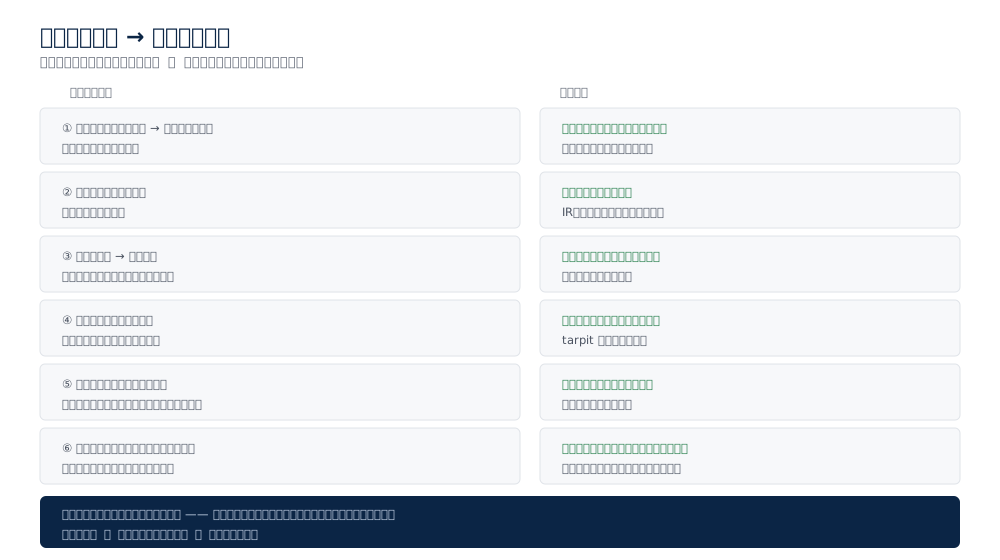
Six root causes, six openings
Cause one: the platform channel degraded entirely in a hardened environment
What failed: the target's PHP environment was hardened (dangerous functions disabled), so the platform's own channel tooling could not register. Every worker abandoned the platform channel and fell back to hand-rolled requests (hundreds), bypassing session management, approvals, and audit trails.
Defensive opening: hardening eliminates an entire attacker toolchain. Disabling dangerous functions and restricting interpreter capability is not a scoring question — it breaks the opponent's tooling.
Cause two: the decisive intent died in the scheduler
What failed: the single most important intent was created and never claimed — stuck in the queue, stalling the attack for roughly thirty minutes.
Defensive opening: an attacker stall is a defender's time window. Incident response, forensics, and isolation should all happen inside it. Queue backlog also leaves traffic signatures (bursts of homogeneous requests, abnormal gaps) usable as early warning.
Cause three: missing tools forced improvisation and produced wrong conclusions
What failed: the attack environment lacked usual tooling (no package sources, no compiler), forcing hand-rolled substitutes that produced four or more wrong conclusions written into shared memory, sending the planner into churn on false premises.
Defensive opening: making the environment hostile is the cheapest speed bump. Egress control, package-source control, and missing common tooling push opponents onto inefficient paths and raise their error rate.
Cause four: budget burn — tunnel vision
What failed: the same crash signature retried a dozen-plus times without giving up; the same target re-registered by multiple workers; a closed conclusion revisited.
Defensive opening: homogeneous responses slow attackers down. Forcing repeated retries that burn budget is effective attrition — the empirical basis for tarpit strategies.
Cause five: shared infrastructure contaminating itself
What failed: multiple workers shared the same file, temp directory, and hard-coded paths, producing crossed outputs and overwrites. Workers misread "interfered with by another" as "I failed" and retried.
Defensive opening: make opponents distrust their own artefacts. Interference, races, and unstable responses amplify an attacker's misjudgement and internal friction.
Cause six: protective rules being "trained around"
What failed: the protective layer auto-adjudicated nearly a hundred interceptions with zero human involvement; collateral damage included a read-only command flagged as deletion and a final report blocked from being written. Workers learned to rephrase to slip past the rules.
Defensive opening (and self-reflection): the real lesson is about ourselves — protective rules that nobody reviews, with no auditable decision record, shift from "protection" to "something to be bypassed". Rules need human participation, review, and iteration.
A checklist you can use directly
Technical hardening
- Is the internet-facing asset inventory complete, and who maintains it?
- Are unnecessary high-risk functions and services disabled on critical systems?
- Is egress control in place (which hosts may go out, and where)?
Credentials and privileges
- Are privileged credentials isolated (just-in-time, segmented)?
- Are service and machine accounts rotated regularly?
- Do administrator accounts exist that open every door?
Detection and response
- Can you detect an "attack stall" (homogeneous requests, abnormal gaps, retry patterns)?
- What is your mean time to respond? When was your last exercise?
Governance and supply chain
- Do external or IT service providers use tooling of this class? Do you have audit rights?
- Do protective rules have auditable decision records and human review?
- Are cyber insurance terms and breach-disclosure obligations clear?
Three one-liners
- Defense does not need to block — it needs to lengthen. The attacker's weakness is the chain (credentials, scheduling, toolchain), not a single point.
- Hardening is a speed bump. A hostile environment degrades the toolchain, forcing improvisation → wrong conclusions → churn.
- Rules need humans. Protective rules without review get bypassed, not obeyed.
Next steps
- To understand the attacker's fixation on credentials, read credentials and AD concepts
- To see how opponents build channels, read tunnel techniques explained
- To study such systems safely in isolation, read isolated research practice
Next on this path
More in Evidence
- Tunnel Techniques Explained: When an AI Agent Needs to Pave a Road into the Internal Network
- Agentic Attack Tooling Research Series: A Guide to All Twelve Parts
- When AI Learns to Pentest: The ARTEX Case and the Rise of Agentic Attack Tooling
- Cloud Identity and Permissions: Where the New Access Cards Live