Agentic Attack Tooling Research Series: A Guide to All Twelve Parts
What this series asks: when attack tooling moves from human-operated to agent-operated, does the defender's standing assumption still hold — that attackers err, stall, and give up? Our answer: it holds, and it is more valuable than ever. Because automation's failure modes are predictable regularities, not inscrutable cunning.
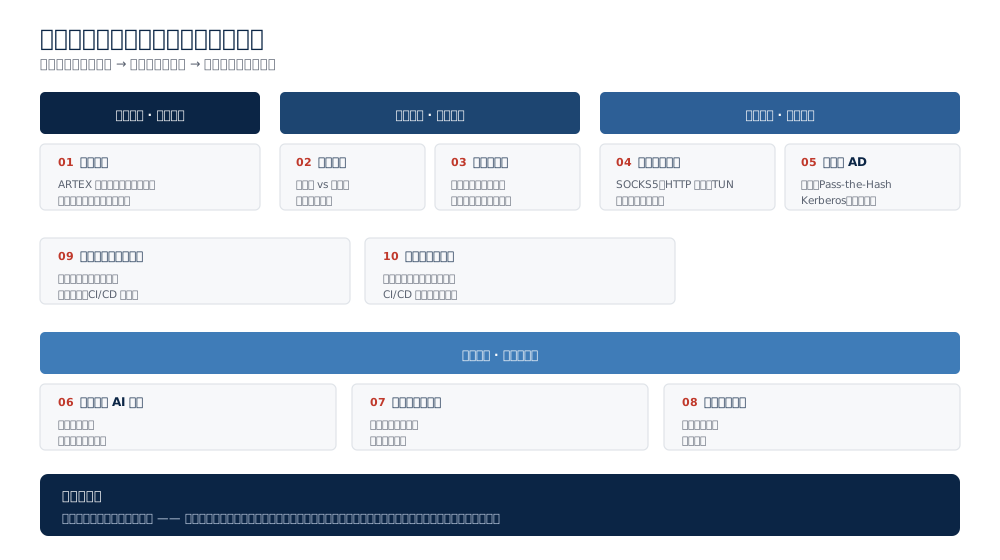
Why this series is worth reading
In October 2026, an open-source AI pentesting tool named ARTEX was linked to attacks on South Korean financial institutions; within 48 hours the developer pulled the source and went closed-source.
The value of that event is not another breach — it is that this is the first publicly attributed case of agent-driven attack tooling with readable source code. Previously we could only infer tradecraft from victim logs. This time the tool's own design logic was public: it can be dismantled layer by layer, and countered item by item.
The ten parts
Part one: understanding the event
01 · Case study: ARTEX and the rise of agentic attack tooling
The timeline, the technical positioning, three mechanisms that lower the barrier — and three real bottlenecks the attacker exposed.
→ /en/discoveries/artex-agentic-attack-tooling
Part two: architecture design
02 · The double-graph architecture
Most systems track state in one table, letting guesses contaminate facts. This piece unpacks the "truth store + reasoning chain" split, with a cross-domain mapping table.
→ /en/discoveries/double-graph-agent-architecture
03 · Multi-agent coordination
Parallelism brings duplication, silos, and mis-ordering. Four techniques respond: role red lines, process-level exchange, a shared todo list, and a single intent generator.
→ /en/discoveries/multi-agent-coordination-patterns
Part three: technical principles
04 · Tunnel techniques explained
How an attacker builds a channel when firewalls block and the target has no egress: SOCKS5 proxy, HTTP-disguised tunnel, TUN virtual adapter.
→ /en/discoveries/agent-tunnel-techniques-explained
05 · Credentials and AD concepts
Why attackers fixate on the administrator password; Kerberos, hashes, pass-the-hash, lateral movement — explained plainly, plus why credential isolation has the highest return.
→ /en/discoveries/credentials-and-ad-concepts
09 · Supply chain and third-party risk (new in this series)
From open-source packages to outsourced providers to cloud dependencies — much of a modern enterprise's attack surface sits outside its own control.
→ /en/discoveries/supply-chain-and-third-party-risk
10 · Cloud identity and permissions (new in this series)
When workloads move to the cloud, credentials change shape: service principals, roles, temporary credentials, CI/CD secrets.
→ /en/discoveries/cloud-identity-and-permissions
11 · The economics of ransomware (new in this series)
Analysing ransomware as a business: cost structure, revenue model, and three levers for making attacks unprofitable.
→ /en/discoveries/ransomware-economics
12 · Insider threat and access governance (new in this series)
Three types of insider threat (malicious, negligent, coerced) need different responses — plus the problem of AI agents as a new insider identity.
→ /en/discoveries/insider-threat-and-access-governance
Part four: defense and practice
06 · Honeypots and anti-agent traps
Four trap classes aimed at AI (attestation induction, reverse prompt injection, tarpit, egress leakage), plus three rules any team whose agents read external content should adopt.
→ /en/discoveries/honeypots-and-anti-agent-traps
07 · Defense lessons from a red-team postmortem
A rare public postmortem honestly lists six root causes. This piece reads each in reverse as a defensive opportunity, distilled into a usable checklist.
→ /en/discoveries/defense-lessons-from-red-team-postmortem
08 · Isolated research practice
Security research requires touching offensive tooling, but "can study" is not "may use". Five isolation layers and five red lines, from a real deployment.
→ /en/discoveries/isolated-research-practice
Suggested reading orders
| Reader | Path |
|---|---|
| Just the event | 01 → 07 |
| Architecture-minded | 02 → 03 → 04 → 05 |
| Defense and risk | 01 → 06 → 07 → 08 → 09 → 10 → 11 → 12 |
| Everything (recommended) | 01 → 02 → 03 → 04 → 05 → 06 → 07 → 08 → 09 → 10 → 11 → 12 |
One line
Defense does not need to block — it needs to lengthen. The attacker's weakness is the chain (credentials, scheduling, toolchain), not a single point. And automation's greatest gift to defenders is this: its failure modes are observable and predictable.
Next steps
- To start immediately: begin with 01 · case study
- For the defensive conclusion: jump to 07 · defense lessons from a red-team postmortem
- To study safely in isolation: read 08 · isolated research practice
Next on this path
More in Evidence
- Tunnel Techniques Explained: When an AI Agent Needs to Pave a Road into the Internal Network
- When AI Learns to Pentest: The ARTEX Case and the Rise of Agentic Attack Tooling
- Cloud Identity and Permissions: Where the New Access Cards Live
- Credentials and AD Concepts: The Most Critical Link in the Attack Chain, Explained Plainly