When AI Learns to Pentest: The ARTEX Case and the Rise of Agentic Attack Tooling
Core question: What happens to the cost curve of attacks when tooling shifts from "human-operated" to "AI-agent-operated"? And does the defender's standing assumption — that attackers make mistakes and get stuck — still hold? Why this case matters: ARTEX is the most complete public sample we have. It comes with readable source code and a rare red-team postmortem, so we can see both the tool's capability boundary and the attacker's real bottlenecks. Angle of this article: architecture and defense research. Everything below is a static reading of source code and public reporting — no testing and no operational guidance.
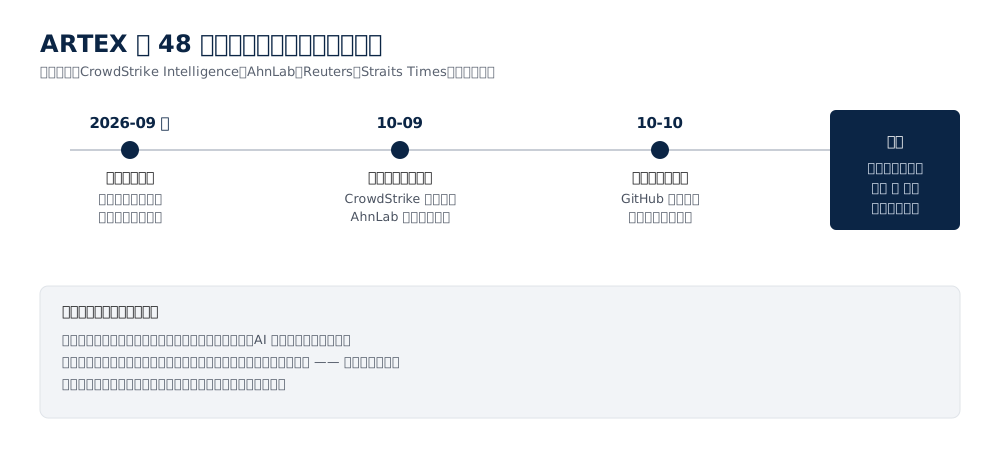
48 hours in the life of an open-source project
From late September into early October 2026, several South Korean financial institutions suffered data breaches. On October 9, CrowdStrike published an analysis noting that a tool named ARTEX appeared in attacker infrastructure; the same day, AhnLab released its own scan of the tool's deployment footprint. On October 10, Reuters reported that the developer had taken the project closed-source and removed the GitHub page.
From "open-source project" to "international news subject" in under 48 hours.
The timeline is worth recording not because another breach happened — but because this is the first publicly attributed case of agent-driven attack tooling with readable source code. Previously we could only infer attacker tradecraft from victim logs. This time, the tool's own design logic was laid out in the open.
What ARTEX is: three defining choices
First, it is multi-agent, not a single AI assistant. The system pairs one planner with multiple workers, plus a goals module that decomposes the operator's objective into verifiable sub-goals. That division of labour lets it pursue several attack paths in parallel.
Second, it manages state with a "double graph". The system splits "what the target is" from "how far we have tested" into two graphs: a globally shared asset graph (domains, subdomains, services, endpoints) and a per-task exploration graph (goals, intents, facts, findings). The two are joined by anchors — so you can trace from an exploration direction back to the assets it touched, or from an asset back to every intent that tested it.
Third, it ships a human-in-the-loop approval gate. Every dangerous tool call passes an interception layer that can allow, deny, or escalate to a human.
Together, these make it a system that can autonomously walk a multi-step attack chain — not merely "an LLM wired to a scanner".
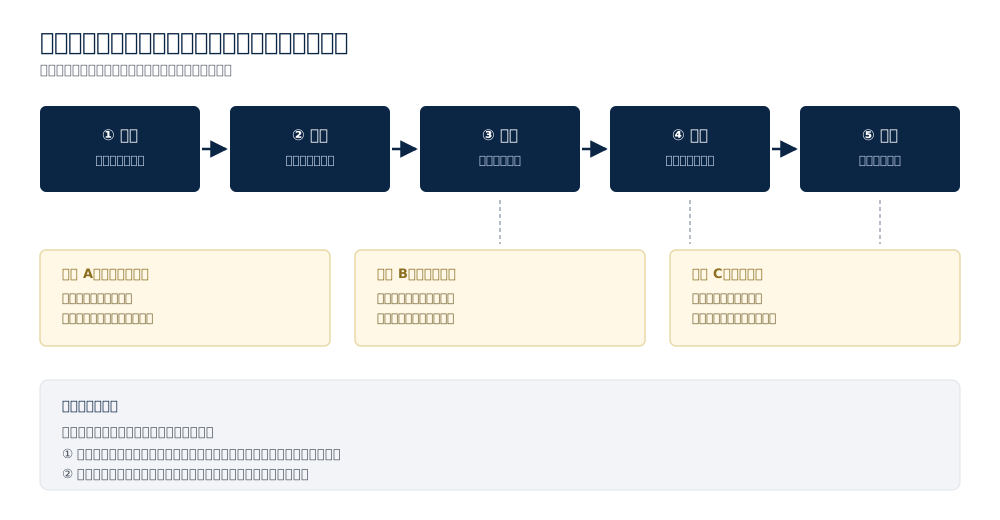
The real watershed: three mechanisms that lower the barrier
Breaches are common. What changed here is the mechanism by which the barrier drops — and those mechanisms are reproducible and scalable.
Mechanism one: outsource judgement to the model. The expensive part of penetration testing was never the tools; it was knowing where to strike next. ARTEX assigns that to the planner: it reads the situation graph, decides which directions remain uncovered, and dispatches intents to workers. Judgement moves from human experience to model inference.
Mechanism two: automate the repetitive pipeline. Scanning, probing, fingerprinting, credential attempts — steps once stitched together by hand are now chained automatically. AhnLab's scan found multiple adjacent services co-resident with ARTEX installs (asset mapping, AI service relays), indicating an assemblable platform rather than a point tool.
Mechanism three: drive the cost of acquisition to zero. Before going closed-source, it was an AGPL-3.0 project anyone could download, deploy, and modify.
But attackers did not get stronger — three real bottlenecks
This section draws on rare public material: the red-team postmortem shipped with the development branch. It honestly lists six root causes — and those root causes are precisely where defenders find opportunity.
Bottleneck one: the credential step still needs a human. In both exercises (before and after fixes), the final mile to completion depended on human-supplied domain administrator credentials. The developer's own conclusion: the platform "can take 80% of the penetration workflow to expert level, but at the credential step it still needs a human."
Bottleneck two: scheduling stalls. The postmortem notes that the single most decisive intent was created and then never claimed by a worker — it died in the task queue, stalling the attack for thirty minutes. Attacker automation is not seamless: queue backlog, intent timeouts, and missing cancellation mechanisms all create meaningful time windows.
Bottleneck three: an unfriendly environment slows everything. When the target environment lacked the attacker's usual tooling (no package sources, no compiler, restricted egress), the system was forced to improvise. That improvisation produced wrong conclusions written into shared memory, sending the planner into several rounds of churn on false facts.
One line for defenders: defense does not need to "block everything" — it needs to lengthen the attack chain. Every link's failure rate compounds along the chain.
Three implications for defenders
Implication one: treat "the attack stalls" as an observable signal. Attackers stall at scheduling, credentials, and toolchain. Those stalls leave traces — bursts of homogeneous requests, abnormal gaps, retry patterns after failure. Detecting the stall moves your detection window earlier.
Implication two: hardening is itself a speed bump. The postmortem shows that target hardening (disabled dangerous functions, restricted egress, missing common tooling) directly degraded the attack system's toolchain and pushed it onto inefficient paths. The question is not whether hardening works, but how much delay it buys.
Implication three: credential isolation has the highest return. Both exercises stalled at credentials. Isolating privileged credentials (just-in-time access, segmentation, least privilege) maps directly onto the weakest link in the chain.
What this means for enterprises
If the cost of attacking falls while the marginal benefit of defending rises, then the gap between organisations that do the basics and those that do not will widen.
Concretely, items worth checking: the completeness of your internet-facing asset inventory, whether privileged credentials are isolated, your mean time to respond, and whether external service providers use tooling of this class. None of these are new questions — but their priority just went up.
Next steps
- To understand ARTEX's architecture, continue with the double-graph architecture and multi-agent coordination articles in this series
- For the technical links in the attack chain, read tunnel techniques explained and credentials and AD concepts
- To learn how to study such tooling safely in isolation, read isolated research practice
- If you are running corporate due diligence, the defense lessons from the red-team postmortem article includes a checklist you can use directly
Next on this path
More in Evidence
- Tunnel Techniques Explained: When an AI Agent Needs to Pave a Road into the Internal Network
- Agentic Attack Tooling Research Series: A Guide to All Twelve Parts
- Cloud Identity and Permissions: Where the New Access Cards Live
- Credentials and AD Concepts: The Most Critical Link in the Attack Chain, Explained Plainly