Read these first
This article assumes the following earlier in its learning path.
Cloud Identity and Permissions: Where the New Access Cards Live
Core premise: in a traditional data centre, an attacker wants "a username and password". In the cloud, they want an identity that is trusted — and that identity may not be human; it may be a program. Angle: concepts and tightening guidance. No operational detail.
The shape of credentials changed; the risk did not
Recall the traditional environment: logging in required a username and password; servers calling each other often used a credential pair written into a config file.
The cloud changed that. Now:
- an application calls a database using a service principal (a program identity);
- a program accessing a storage bucket receives a temporary credential (with an expiry);
- a deployment pipeline needs a secret, possibly stored in a CI/CD environment variable.
The shape changed, but the attacker's objective did not: obtain a trusted identity.
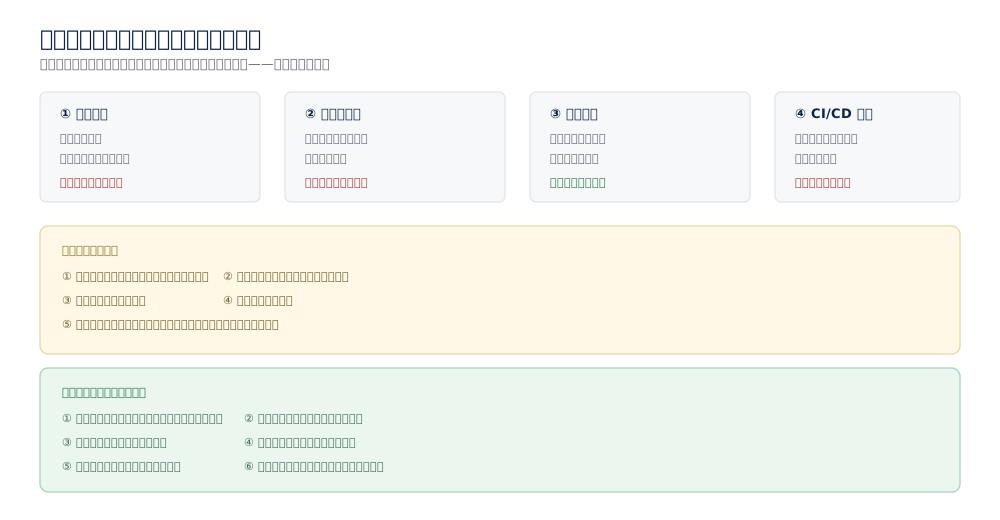
Four concepts worth separating
Concept one: service principal / service account
Plainly: an identity that is "not a person", representing an application or automation.
Why it matters: people leave, change passwords, and attract audit attention; service principals are often long-lived, permanently valid, and rarely reviewed. If a credential leaks, it may go unnoticed for years.
Concept two: roles and permission bindings
Plainly: cloud platforms do not grant permissions directly to an identity. They define a role (what may be done), then bind that role to identities.
Why it matters: the design exists for flexibility and manageability, but the practical failure is over-broad binding — more permission than needed, rarely narrowed.
Concept three: temporary credentials
Plainly: a credential with an expiry. It stops working when the time is up.
Why it matters: this is the cloud's biggest security dividend over traditional environments. A long-lived key that leaks is a permanent gap; temporary credentials compress the exposure window to hours.
A useful test: if your environment contains lots of long-lived keys, the answer is simple — everything that can move to temporary credentials should move.
Concept four: CI/CD secrets
Plainly: credentials the automation pipeline needs.
Why it matters: these secrets usually carry broad permissions (deploy, change configuration, read other secrets) and live in repositories or build systems — so a leak has wide blast radius.
Five most common blind spots
Blind spot one: long-lived keys scattered everywhere
The common state: multiple systems each hold a long-lived key, and nobody knows how many exist, when they were created, or who uses them.
Tightening: start with an inventory — "how many long-lived credentials do we have, and where?" Many enterprises are startled by their first count.
Blind spot two: over-broad permissions ("it is all internal anyway")
When binding roles, people often grant a wide scope to avoid mistakes.
Tightening: start from least privilege and add as needed — not the reverse.
Blind spot three: accidentally public buckets and services
The classic cloud incident: a storage bucket is misconfigured and readable by anyone.
Tightening: automate the check for public access settings rather than relying on memory.
Blind spot four: logs enabled but unread
Enabling audit logs is good; if nobody reviews them and no anomaly alerting exists, they only consume storage.
Tightening: name who reviews, how often, and what triggers an alert.
Blind spot five: offboarding and vendor processes miss the cloud
HR changes revoke internal system access, but cloud service principals and vendor role bindings are frequently overlooked.
Tightening: put cloud permissions on the same "staff/vendor change checklist".
A practical tightening order
Ranked by return, proceed in this order:
- Inventory: list all long-lived credentials, all service principals, all publicly exposed resources;
- Go temporary: replace every long-lived key that can become a temporary credential;
- Narrow: reduce each permission binding to what is actually needed;
- Watch: name an owner and define alert conditions;
- Process: add cloud permissions to staff and vendor change checklists;
- Review: quarterly check of "who has what, and is it still needed".
Why this connects to AI agents
Connect the pieces: the resource attackers — human or agent — chase hardest in the chain is credentials. In a cloud environment there are far more credentials than in a traditional one: every service principal, every pipeline, every automation is a potential credential.
That means credential isolation is harder in the cloud — and more valuable.
Three one-liners
- Cloud identities are not only people. Service principals are often more dangerous than human accounts because they are reviewed less.
- Temporary credentials are the biggest dividend. Move whatever can move — it turns a permanent gap into a few-hour gap.
- Narrowing happens one step at a time. Nobody gets it right in one pass; every pass should move the right direction.
Next steps
- For supply-chain risk (cloud dependency is one link), read supply chain and third-party risk
- For credentials in traditional environments, read credentials and AD concepts
- For an overall defensive review, read defense lessons from a red-team postmortem
Next on this path
More in Evidence
- Tunnel Techniques Explained: When an AI Agent Needs to Pave a Road into the Internal Network
- Agentic Attack Tooling Research Series: A Guide to All Twelve Parts
- When AI Learns to Pentest: The ARTEX Case and the Rise of Agentic Attack Tooling
- Credentials and AD Concepts: The Most Critical Link in the Attack Chain, Explained Plainly