The 74k-star Open-Source Life Guide: What Its Evidence Grading Is Worth Copying
A free book that reached 74,249 stars in two months
In 2026, a GitHub repository called eternity4719/HowToLiveBetter appeared. It is not a codebase. It is a complete book: 34 chapters, about 2.4 MB of text, and 772 numbered recommendations. Behind those recommendations sit 2,597 links to primary literature. The official ebook edition is published exclusively by Guomai Culture (October 2026), while the source text remains freely available under CC BY 4.0.
Why it spread is not mysterious. Everyday advice usually comes in two flavours: motivational content with no sources, or professional guidance that is precise but unreadable. This book does a third thing — it turns "it makes sense" into "how much it costs, what it buys, and how solid the evidence is."
How one recommendation is written
Every entry follows the same skeleton: a machine-readable cost tag (money, time, willpower, benefit, and the unit of benefit), then the cost, a plain-language explanation, the benefit, an evidence grade, the source, and a note covering exceptions and disputes.
The fixed structure is what makes the book comparable. A reader can put two recommendations side by side and see which costs less and returns more.
Two design choices stand out. First, the "unit of benefit" is explicit: one entry may be measured in mortality, another in money. The book refuses to silently convert between them. Second, the plain-language paragraph is mandatory. Technical wording is explained before the reader is asked to act.
What A/B/C actually look like
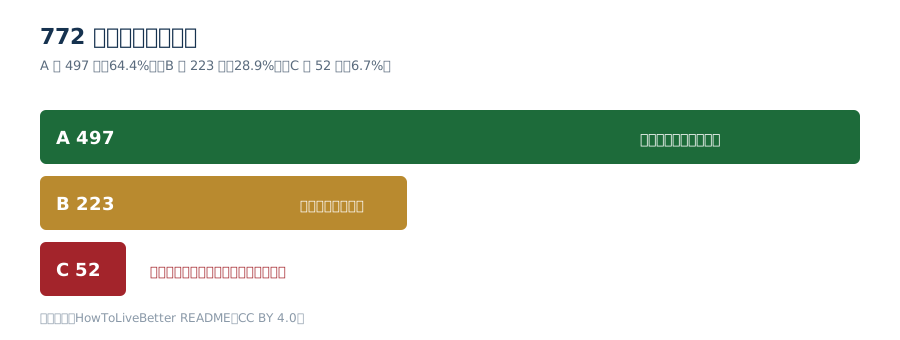
Of the 772 recommendations, 497 are graded A (64.4%), 223 are B (28.9%), and 52 are C (6.7%). The three grades add up to the full set — there is no "ungraded" remainder.
The distribution matters more than the labels. A grade means high-quality research with multiple sources in agreement. B means there is evidence but it remains contested. C means a single source or preliminary work.
Most advice books quietly drop the C tier. This one keeps all 52, marks them, and lets the reader decide. That is a statement about intellectual honesty: the value of a grading system is not proving the book right, but telling the reader where it might be wrong.
Our own model: T0 to T5
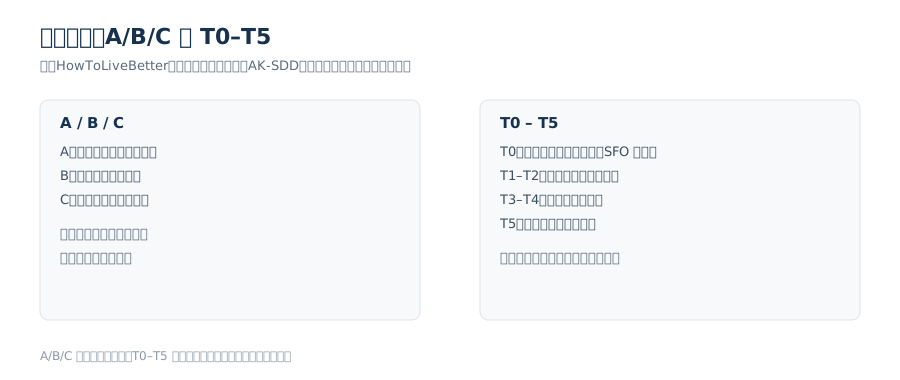
For Hong Kong listed-company research we use a different scale: T0 to T5. The two systems share a purpose — converting "trust me" into an explicit label — but they measure different things.
| Dimension | HowToLiveBetter (A/B/C) | AK-SDD (T0-T5) |
|---|---|---|
| Number of tiers | Three (A/B/C) | Six (T0-T5) |
| Basis | Strength of evidence and consensus | Legal status and verifiability of the source |
| Top tier | High-quality research, multiple sources | T0: statutory filings (annual reports, SFO disclosures) |
| Bottom tier | C: single source or preliminary study | T5: rumour and unverified reporting |
| Where it is applied | Each recommendation, with source links | Each data point, with page and original wording |
| Typical use | Personal life decisions | Listed-company due diligence and reporting |
One asymmetry is worth naming: T0 is the strongest tier, and higher T numbers are weaker. In our reports, a number that appears only in a discussion section (T5) does not enter the conclusion no matter how plausible it sounds. In the life guide, a C-grade recommendation can survive — it is simply flagged.
The deeper difference is granularity. A/B/C grades an entire recommendation. T0-T5 grades an individual figure, tied to a page number and the original sentence. Financial reporting needs that precision; personal advice does not.
Three things worth borrowing
First, keep the four currencies separate. Our reports often collapse liquidity risk, leverage risk, and financial risk into one score. Readers do not want a single number — they want to know how big each risk is. Grading them separately is more useful than merging them.
Second, record the counter-evidence. The book does not hide contested recommendations; it puts the opposing view in the note. The same discipline applies to research: a report that lists only supporting evidence is less valuable than one that states what would falsify the conclusion.
Third, date the policy-dependent claims. Recommendations about subsidies, deadlines, and eligibility carry an explicit "as of" date. Our reports do the same for regulatory facts, which avoids the situation where a three-month-old figure is presented as current.
Two things not to copy
A general guide cannot replace professional judgement. The book says so itself: for a specific illness, case, or tax position, it offers direction, not a decision.
And the policy context is mainland China. Amounts, deadlines, and procedures do not transfer to Hong Kong or elsewhere without checking the local rules.
Closing
The most useful part of HowToLiveBetter is not its advice. It is the habit of attaching a cost, a benefit, an evidence grade, and a source to every claim — and then keeping the weak claims visible instead of deleting them.
That habit is portable. Whether the subject is a life decision or a balance sheet, the question is the same: how much does this cost, what does it return, and how would I know if I were wrong?
Source: github.com/eternity4719/HowToLiveBetter (CC BY 4.0). This article is an independent review; all figures are quoted from the repository's README as of 2026-11-09.
More in Learn
- The Eight Acceptance Gates for AI-Generated Reports
- DeepSeek's Open-Source Super-Agent Prototype: A Source-Level Breakdown
- PStack Deep Dive (Part 1): How a Cursor Plugin Turns Engineering Discipline into Executable Files
- PStack Deep Dive (Part 2): Two Agents, Five Special Designs, and How It Actually Lands